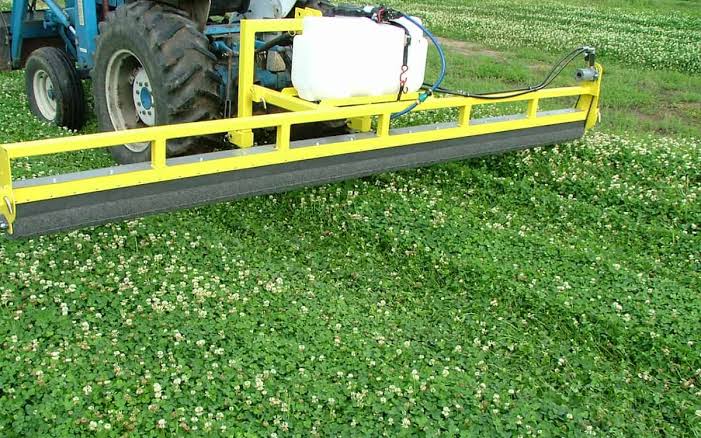
Most paddocks don’t need a full spray. They need the thistles dealt with and the grass left to grow. A boom pass treats every plant in its path, including the pasture you want to keep. That’s chemical spent on ground that was never the problem.
A weed wiper carries wet wicks at a set height and treats only the plants tall enough to touch them. Where weeds stand above the pasture, you can take them out while the grass underneath keeps producing.
How a Weed Wiper Reduces Herbicide Use
Wiper mixes are far more concentrated than boom mixes, so a label rate for wick application can look alarming at first glance.
The savings come from how little of the paddock you cover, not from the strength of the mix. A wiper only treats what makes contact, so even at a stronger dilution the total product used across the paddock usually lands well under a blanket pass. The more scattered the weeds, the bigger the difference.
Preparing the Paddock Before You Wipe
This step decides whether you get a clean result or a patchy one, and it’s the one most people skip.
The weeds need to be standing clear of the pasture. Graze the paddock hard or slash it, pull stock off, then wait. Fireweed, thistle and African lovegrass all recover faster and grow taller than the pasture around them, so the height difference opens up on its own. Three to six weeks is usually enough, depending on season and moisture.
Aim for more than the bare minimum of clearance. Wiping with 50mm between the wick and the top of the grass means scrubbing pasture on every rise and hollow. A clear 100mm or more lets you hold a steady height across ground that isn’t flat.
Which Weeds Suit Weed Wiping
Wiping suits upright weeds that sit above the pasture. The common targets in Australia are fireweed, African lovegrass, serrated tussock, bracken and thistles, along with rat tail grass, rushes in wet country, juvenile gorse and Cape tulip through parts of SA and WA.
Some of these carry legal obligations. Serrated tussock and fireweed are regulated in New South Wales and Victoria, so control is a duty rather than a choice. Your council or Local Land Services office can confirm how a weed is classified locally.
Getting the Setup Right
Only use products registered for wick or wiper application, and follow the label directions for that method. Wiper directions sit separately from boom directions, and the dilution is usually quite different.
Wicks need to be soaking wet without dripping. Too dry and you’re dragging fabric over the weeds without transferring much chemical. Too wet and it runs down onto the pasture you’re protecting. Carpet wicks spread chemical more evenly than the older rope style, and two rows give a second point of contact on every plant.
Travel slower than you would with a boom, since contact time does the work. Weeds also need to be actively growing, so drought-stressed or frosted plants will give a poor kill. On woody weeds, a second pass in a different direction picks up anything that bent away on the first run, and a bruise bar ahead of the wicks damages the plant so the chemical penetrates further.
Choosing a Weed Wiper for Your Property
Most trailed machines tow behind a quad, UTV, ute or tractor and feed the wicks from a tank with a 12V pump. Three-point linkage and front-end loader mounts are available where a tow ball isn’t practical.
Widths start around 1.9m for small blocks and house paddocks, and run out to 6.2m for open country, with folding wings on the larger models so you can get through gateways. Wheels mounted on those wings help the machine follow ground contours across a wide pass.
Beyond width, the things worth comparing are frame construction, wick design and height adjustment range. Hot-dipped galvanised box section holds its shape where lighter folded sheet doesn’t, and wiping height up to 500mm gives you room against tall pasture or serrated tussock. It’s worth looking at weed wipers on those points rather than price and width alone. Some councils also run loan schemes, which is a practical way to try one before buying.
When a Weed Wiper Is Not the Right Choice
Weeds at or below pasture height are out of reach, so capeweed, flatweed and other rosette growers need a different approach. A handheld wick applicator covers those, plus fence lines and tree bases.
Where weeds have taken a paddock outright, there’s no pasture left worth protecting, and spraying out followed by a resow is usually the better option. Very rough or steep ground also makes it hard to hold a consistent wiping height.
Used in the right paddocks, wiping regularly cuts more than the chemical in a single pass. Taking out mature plants without setting the pasture back keeps the grass competitive, and a thick sward is the cheapest weed control on any property.